.png?width=1500&height=398&name=CO_Corporate%20Logo%202021_4C_HOR_FNL-1%20(1).png)
The Chief Outsider
.svg)
Recent Posts

The CEO Dashboard Should Show Direction, Not Just Activity
If your dashboard only tells you what happened, it’s reporting history. A CEO needs direction.
Steps Taken Aren’t the Same as Direction
I've spent a fair amount of time backpacking, and one thing becomes obvious when you've been walking for several hours: knowing how far you've walked isn't the same thing as knowing whether you're headed in the right direction.
Your watch can tell you that you've taken 22,000 steps.

The One Strategic Marketing Question to Ask
Wed, Jun 4, 2014 — When consulting with businesses, one of the fundamentals I look at is whether their business strategy and marketing efforts are in alignment. Just like a well-aligned vehicle will always move confidently in the right direction, so, too, will a business relationship – provided there’s the right connection between what your customers value, and what you provide. Many times, I will hear companies boast of offering great quality, cost and delivery; how they are innovators; and how they have the best technical support teams. The reality is that it’s quite rare for a firm to be the best at everything – and often, pursuing such a superlative-laden strategy can often be a suboptimal marketing strategy to pursue.

Sales and Marketing: Different or Two Sides of the Same Coin?
Tue, May 6, 2014 — Sales and Marketing: Why Can't We All Get Along? How many times have we all heard about the discord between the Sales and Marketing organizations? This discord intensifies based upon whether you work in a Sales or Marketing driven culture. A CEO recently asked me why these two organizations don’t work well together, and how he can improve their overall relationships, and more importantly their individual and collective effectiveness.

Who Are the Top Business Consulting Firms in Charlotte, NC?
Wed, Apr 30, 2014 — Top Business Consulting Firms Based in Charlotte, NC There are a wide range of consulting firms and business advisory formats available to CEOs and Presidents in Charlotte, North Carolina. As a marketing consultant, I’ve had the opportunity to work with and observe a range of firms, gaining insight into the strengths of various consulting formats.

80% of CEOs Have Lost Trust in Their Marketers
Wed, Feb 19, 2014 — The following blog is Part II to my recent blog Over 70% of CMOs failed to deliver expected real ROI for their efforts in 2013 The breadth of discontent among companies with their marketing begs a further look at the why? How have CMOs become less well regarded than say their IT peers, who have something in the neighborhood of a 50% success rating for their projects? Why is the role of the CMO oftentimes the most precarious in the c-suite? Why are 80% of CEOs unhappy with their marketing talent? The consensus seems to be skill level. While many marketers are strong in one or two or even more areas across the board, strength in both left and right brain functions is rare. And oftentimes, the lure of a good creative can be seductive to a CEO, but at the expense of solid business acumen, disappointment is a sure thing. Few marketers have the finance, technical or operations knowledge to effectively lead business modeling, strategy, and positioning as well as marketing functions such as operations and technology, so instead focus on the ‘softer’ or more tactical aspects of the role.
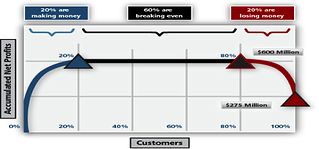
Customers Are Not All Equal
Fri, Feb 14, 2014 — Why it’s important to understand customer value, and what to do about it Every Management Team knows the intricacies of their respective P&L, but can they honestly say they understand the value that each customer delivers to their franchise? More importantly, if they have gone through the hard work of developing a robust customer profitability analysis, have they taken the next step to implementing key business changes based upon the data?(http://www.journalofaccountancy.com/Issues/2008/Dec/ManagingCustomerProfitability.htm) I have worked for some of the leading Fortune 50 companies over my career, where the Leadership Teams actively managed their P&L’s to ensure top and bottom line growth. Not until I was “tapped on the shoulder” to take a senior leadership role in one of our “challenged” businesses, did we even start the discussion about how much each of our customers brought to the bottom line. It was important as we treated every customer the same – meaning, they received superior customer service. Theoretically, we would never consciously bring in unprofitable customers, but the reality was that every customer didn’t bring the same value to the bottom line.

5 Marketing Strategies Community Banks Use to Move Past Competitors
Sun, Dec 22, 2013 — A recent Wall Street Journal article by Francesco Guerrera, Lenders Looking All Too Similar, quoted a tycoon as stating he chose his financial services on price, because “in the end, banks are really all the same”. This is the last thing any of us want to hear about our business, especially if we are in an industry that prides itself on spending a great deal of time developing an understanding of our customers and creating and marketing solutions designed to appeal to their unique needs. Supporting the belief that strategic innovation can make a difference, Bloomberg BusinessWeek’s article Rural Banks Know Something Big Banks Don’t by Brendan Greeley argues that great customer service combined with other good business practices can produce a good return for shareholders.Over the past year I’ve had the opportunity to work with several community banks and credit unions, and have been impressed with how they are able to defy the premise of the WSJ article. Here are 5 marketing strategies on how nimble organizations have been able to understand their customer and move faster and/or smarter than their larger competitors.

David vs. Goliath: How small companies can create marketing that stands up to big brands
Sat, Dec 21, 2013 — Here’s the question: When competing for the hearts and minds of prospects and customers, how do smaller companies effectively compete with the big spending of big brands? Underdogs like me want to know.

The Buying Process Has Changed: How Well Has Your Marketing Adapted?
Sun, Dec 8, 2013 —
The Elton John Brand – Lessons in Marketing Management from The Rocket Man
Wed, Nov 20, 2013 — I read with interest several recent Elton John interviews in support of his latest (33rd) album release, The Diving Board. In a WSJ interview, the album is praised for being a return to the basic style that had Elton continuously on the Top 40 charts for over 4 years during the mid-70’s. The articles made me think about how a brand that started strong can survive for so long putting out some questionable products, and what lessons about marketing strategy we can we take from this.